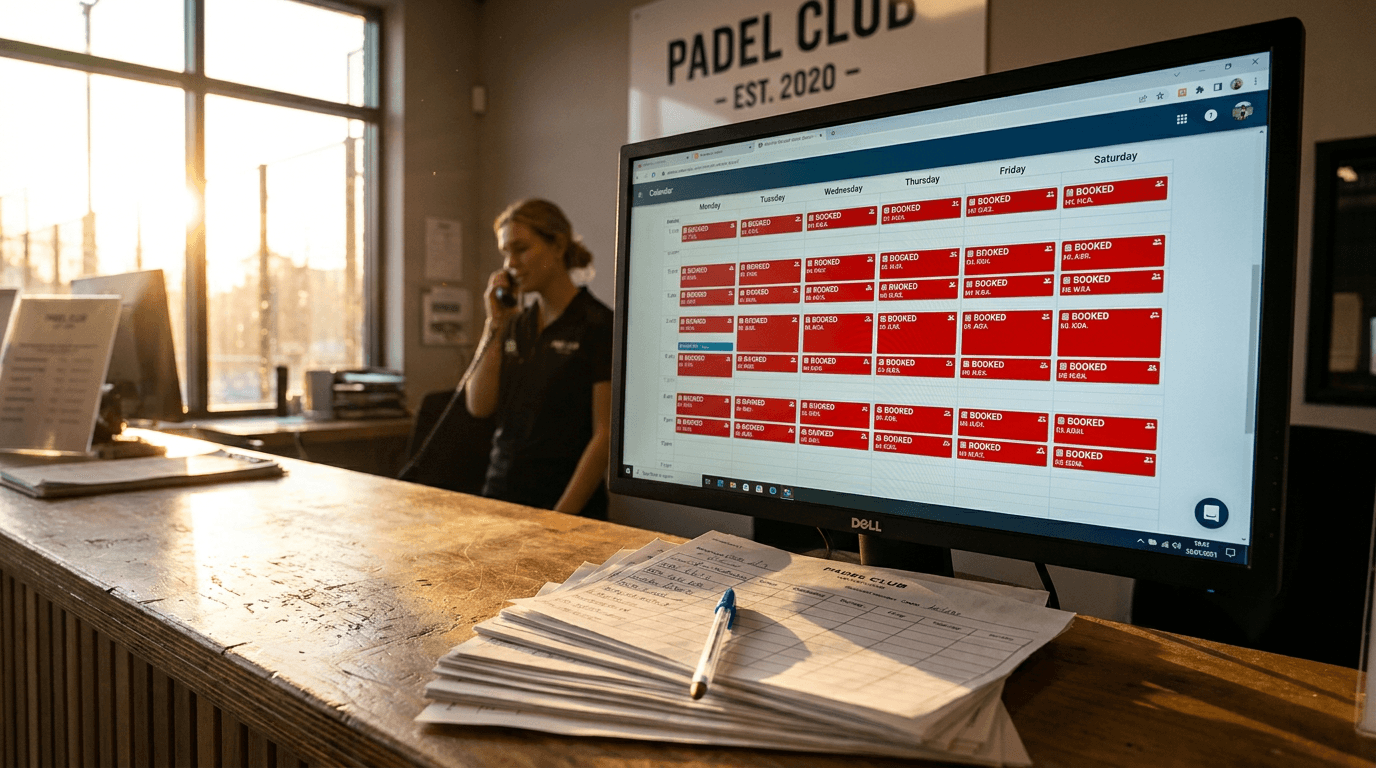
Widely cited industry figures put the US padel player base at around 100,000 in 2023, climbing to something closer to 500,000 by 2025, roughly a five-fold increase in about two years. Growth on that scale, in that short a window, is rare for any sport, let alone a fairly niche one entering an already crowded US fitness and recreation market.
A few things lined up at once. Padel is genuinely easier to pick up than tennis for a first-time adult player, which matters in a market full of people looking for low-barrier group fitness and social activity. It's also relatively cheap to build a court compared to other racket sports facilities, which let operators expand supply quickly once demand signals showed up. And padel's already-massive base in Spain and Latin America gave the sport built-in cultural momentum and an existing playbook for how clubs and social formats should work.
A five-fold jump in players sounds enormous, and it is, but it's easy to read too much precision into a number like this. Player counts in a fast-growing, decentralized sport are usually rough industry estimates rather than an actual census, aggregated from club membership data, app sign-ups, and survey extrapolation. The real takeaway isn't the exact figure, it's the direction and the speed, which are consistent across every source that's tracked this.
Rapid growth on the supply side, courts and clubs, moving faster than the growth on the organizational side, ratings and matchmaking, is exactly the pattern that leaves new US players stuck figuring out their level from scratch at every new club they try. If you're picking up padel as part of this wave, Rally gives you one consistent rating from day one instead of restarting the guesswork at every club.
For the bigger global picture, see our piece on padel's worldwide growth. And if all this growth has you curious about trying the sport, here's an honest look at how hard it is to learn.
Your Empty Courts Are Our Supply Problem, Not Yours
Idle court time isn't just a revenue gap for venues. It's the exact problem Rally exists to solve, from the player side in.
Read
Padel Is the World's Fastest-Growing Racket Sport, and It Still Runs on Group Chats
Padel's global numbers are genuinely wild. Here's what the growth actually looks like, and why the way people organize a game hasn't caught up.
Read
Starting a New Sport as an Adult, Alone: How to Actually Get Your First Game
Trying a new sport without an existing friend group is a specific kind of anxiety. Here's how to get past it and actually get on court.
Read